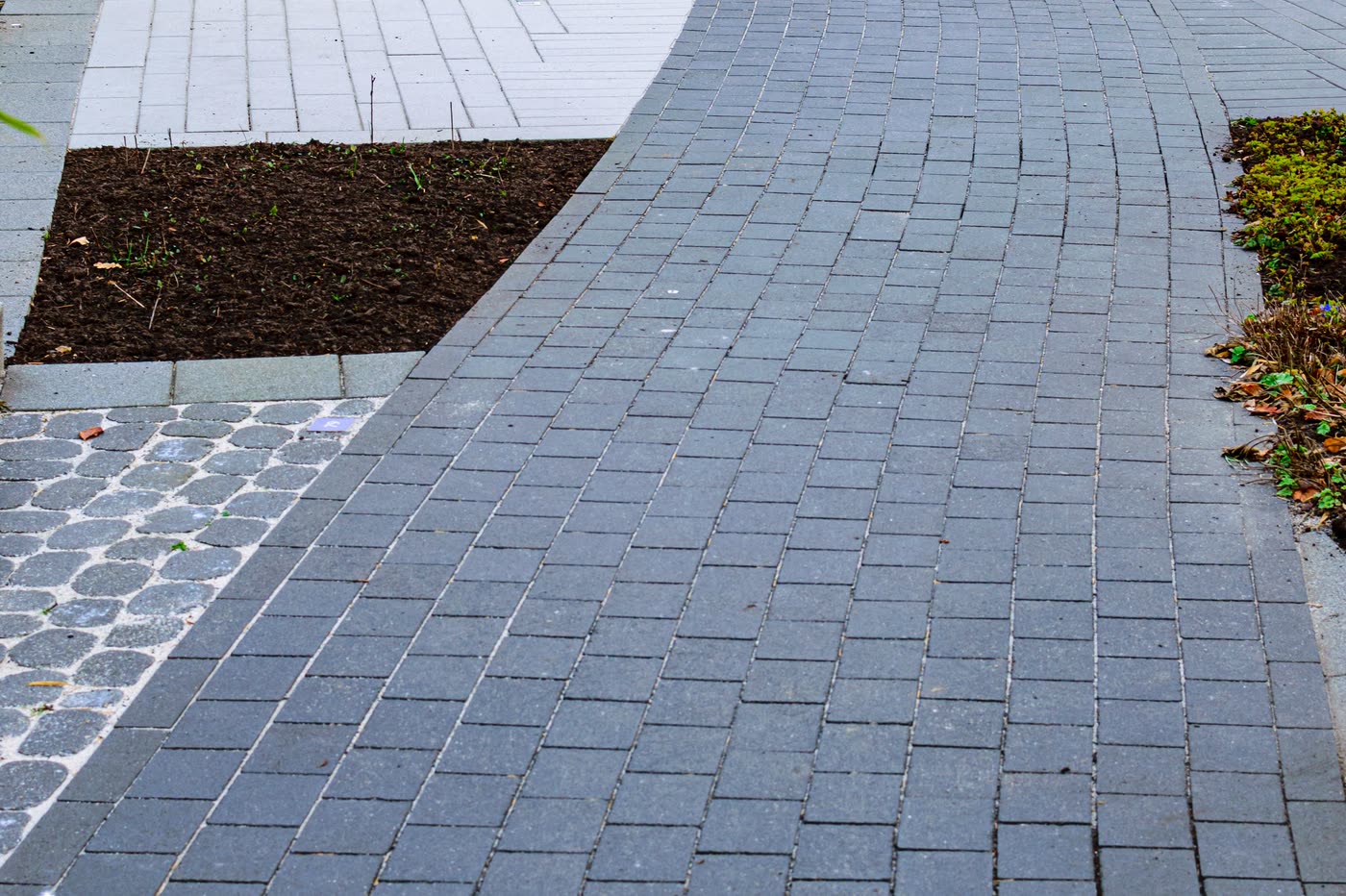
Surfaces
Block paving driveways.
The most popular driveway surface in the UK, and the one where the gap between a good installation and a bad one is widest.
- Cost
- £80–£140/m² installed (indicative)
- Lifespan
- 20 years+ when built properly
- Laying course
- 30–40mm screeded sharp sand
- Best feature
- Repairable in sections, invisibly
- Written, itemised quotesExcavation, sub-base, edging and drainage priced separately
- Site survey before pricingNobody prices a driveway properly from a satellite photo
- Compliant surface water drainageBuilt to meet the 2008 permeable-surface rules, not around them
- Local installers onlyCrews working their own patch, not a national call centre
Block paving is small units laid on a screeded sand bed over a compacted stone sub-base, held together by friction between the blocks and by restraint at the edges. Nothing is glued or bedded in mortar, which is exactly why it works: it flexes slightly under load and can be lifted and relaid.
That last property is the strongest practical argument for it. If a service trench has to go through your drive, or a small area settles, block paving is the only common surface where the repair is genuinely invisible.
Almost every failed block drive fails in one of three ways, and all three are installation faults rather than material faults. Ruts along the wheel tracks mean the laying course was used to make up levels instead of being kept to a consistent 30–40mm. Creeping and opening joints mean there is no proper edge restraint. A general sinking across the whole area means the sub-base was too thin or was never compacted in layers.
Clay pavers or concrete blocks
Concrete blocks are what most UK drives are laid in: cheaper, available in every colour and profile, and modern ones are far better at holding their colour than the 1990s stock that faded to grey and gave the material its reputation.
Clay pavers cost noticeably more. The colour is the fired clay itself rather than a pigmented surface layer, so it does not fade at all, and against a brick house they read as the same material rather than as an imitation of it. On a period property they are usually worth the difference.
Bond patterns
Herringbone at 45 or 90 degrees is the only common bond that properly interlocks against the braking and turning forces a car applies. It is the default for anything trafficked and it is what we lay in wheel tracks.
Stretcher bond and basketweave are weaker under traffic. They look good and are better used for a border, a path or a patio. A double-block border in a contrasting colour around the perimeter is the standard finish and does a practical job as well as a visual one: it gives the field a clean line to be cut against.
Permeable block paving
Permeable block paving is a different system rather than a different block. The joints are wider and filled with angular grit instead of sand, and the layers below are open-graded stone that stores water and lets it drain away, rather than a dense sub-base that sheds it.
It costs more per square metre than standard block paving. In exchange it removes the surface water problem entirely and keeps you clear of needing planning permission for a front driveway. On clay it has to be designed rather than simply specified, clay will not accept water quickly, so the sub-base needs enough void space to hold a storm and release it slowly.
Costs and comparison
| Type | Typical £/m² | Colour behaviour | Notes |
|---|---|---|---|
| Concrete block | £80–£120 | Modern ranges hold colour well | The default. Widest choice of colour and profile. |
| Clay paver | £110–£160 | Does not fade, colour is the material | Best against brick and period frontages. |
| Permeable concrete | £95–£140 | As concrete block | Solves drainage and planning in one. Needs design on clay. |
| Setts (concrete) | £90–£130 | Good | Small units, more labour, suits curves and borders. |
FAQ
Common questions.
How long does block paving last?
Twenty years and beyond on a proper build-up, and it can be lifted and relaid rather than replaced. On a thin sub-base with sand used to level out the base, rutting starts within a few years.
Does block paving need sealing?
No, it is optional. Sealing can reduce staining and slow weed growth in the joints, and it deepens the colour. It also has to be redone every few years, and a poor sealer application can leave a patchy sheen. Plenty of well-built drives are never sealed and are fine.
Why is my block paving sinking in one spot?
Usually a localised sub-base problem, often around a manhole, a gully or where a trench was backfilled and not compacted properly. It is generally fixable by lifting that area, correcting the base and relaying the same blocks.
Can block paving be laid over concrete?
Sometimes, if the concrete is sound, the drainage can be resolved and the extra height does not create a step at a door or garage threshold. It saves the excavation cost. Over cracked and moving concrete it inherits the problem.
What sand do you use for block paving?
Sharp sand for the laying course, screeded to a consistent depth and never used to level out a bad sub-base. Kiln-dried silica sand for the joints, brushed in dry and topped up once traffic has settled it. Building sand in either place is a common and expensive mistake.
Is block paving permeable?
Standard block paving is not, the blocks are solid and the joints are narrow. Permeable block paving is a specific system with wider joints filled with angular grit over an open-graded sub-base, and that is what satisfies the drainage rules without a soakaway.
Should I seal block paving?
Optional, and genuinely not always worth it. A sealer makes future cleaning easier and deepens the colour, but it needs redoing every three to five years and it will not stop weeds on its own. Full joints do more than any sealer.
Can you lay block paving on sand and cement?
You can, and for a driveway you generally should not. A rigid mortar bed cracks as the ground moves and takes the blocks with it, and it removes the one real advantage of block paving, which is lifting and relaying a section invisibly.
How much does block paving cost?
Roughly £80 to £140 per square metre installed as an indicative regional range. Where a quote sits in that band is decided by excavation depth, how much spoil has to be carted away, and the edge detail, not by the blocks.
Related pages
Written and reviewed by the PaveLocal team. We build and specify driveways across Northamptonshire, Buckinghamshire and Bedfordshire. Pricing and specification guidance on this page reflects what these jobs cost and involve in this region, not a national average.
Free quote
Get a free quote.
Send your postcode and a rough size and we will arrange a survey. A photo of what is there now tells us more than a paragraph does.
- Itemised, in writingExcavation, sub-base depth, edging, drainage and surface priced as separate lines, so you can compare quotes properly.
- Surveyed before it is pricedGround conditions decide the cost of a driveway. Anyone quoting a firm price off a photo is guessing.
- No obligationA quote is a quote. If you use someone else, that is fine, we will not chase you about it.
Prefer to talk it through? Call 07423 123796, message us on WhatsApp or email info@pavelocal.co.uk.