Driveway guide
How to lay block paving
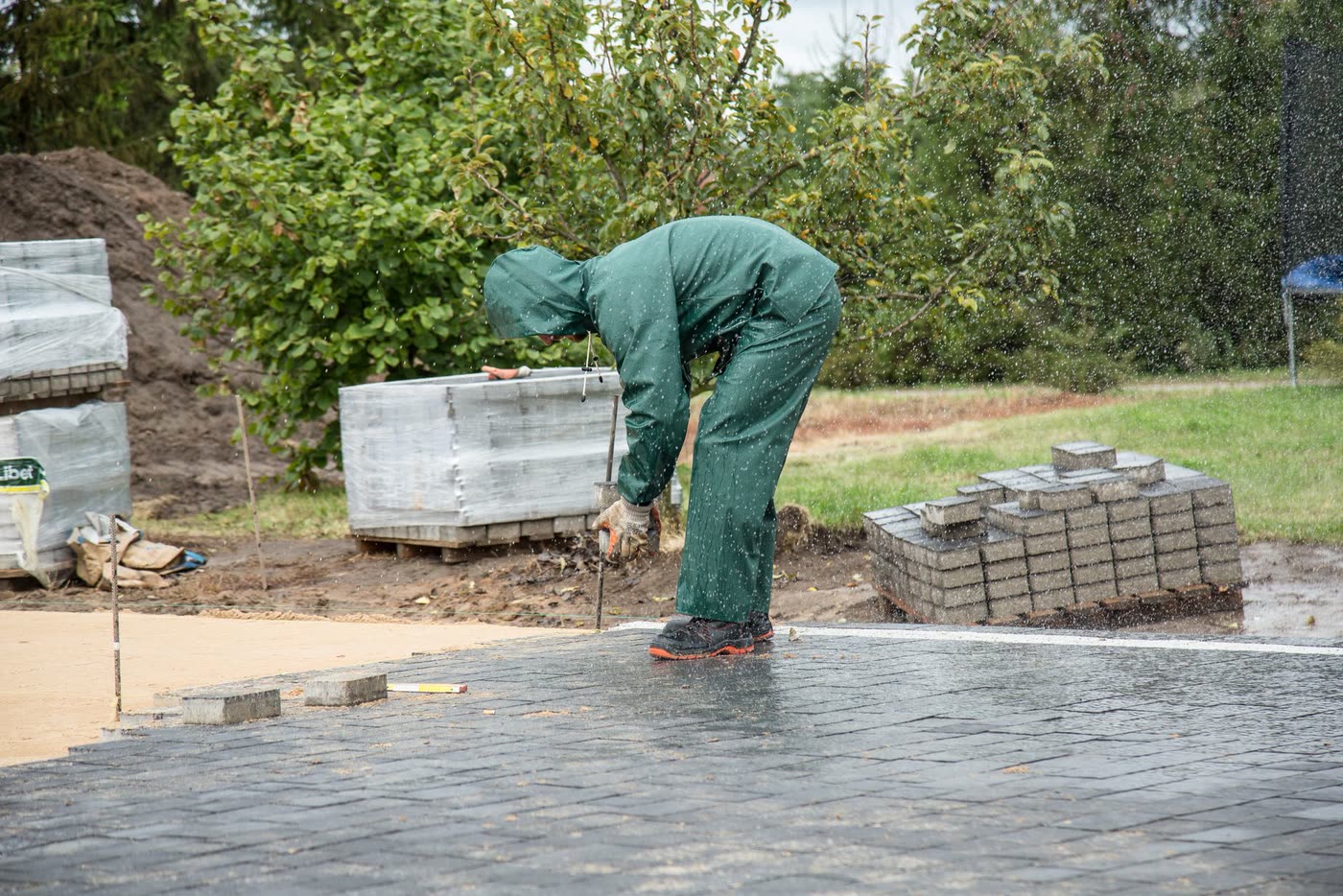
How do you lay block paving?
Excavate 250–300mm below finished level, lay a geotextile membrane, then 150–200mm of MOT Type 1 compacted in layers. Bed edge restraints in concrete on both sides. Screed 30–40mm of sharp sand, lay blocks in a 45° or 90° herringbone bond, cut the edges, vibrate the surface, then brush kiln-dried sand into the joints in repeated passes.
This is how to lay block paving properly, which is worth knowing whether you are doing it yourself or checking someone else's work. Block paving is the most-attempted DIY driveway surface in the UK, and the one where the difference between a twenty-year drive and a five-year one is entirely in layers nobody can see once it is finished.
What are the layers, in order?
- 1. Excavate
Dig to 250–300mm below the finished level for a car drive. Cart the spoil away, this is a real cost and a real volume, roughly 12 cubic metres on a 40m² drive. Check for services before you dig.
- 2. Geotextile membrane
Laid over the formation to stop the sub-base stone punching down into soft ground over the years. Cheap, and constantly skipped.
- 3. Sub-base
MOT Type 1, laid and compacted in 75–100mm layers with a plate compactor, not tipped in one lift and rolled once. 150mm on free-draining ground, 200mm or more on clay. This is the structural layer.
- 4. Edge restraint
Kerbs or edging blocks bedded and haunched in concrete on both sides, set to the finished levels and falls. Laid before the field, so the field is cut to fit it.
- 5. Laying course
30–40mm of screeded sharp sand at a consistent depth. Screed it off rails and do not walk on it.
- 6. Blocks
Laid to the bond from a fixed line, working off the laid blocks rather than the screed. Cut the perimeter last with a disc cutter or block splitter.
- 7. Vibrate and joint
Run a plate compactor with a rubber sole over the surface, then brush kiln-dried sand into the joints and vibrate again. Repeat until the joints stop taking sand.
What sand do you use for block paving?
Two different sands, and mixing them up is the most common DIY mistake.
- Laying course: sharp sand
Coarse and gritty. Screeded to a consistent 30–40mm. Never building sand, which is too fine and holds water.
- Joints: kiln-dried sand
Fine and completely dry, so it flows into the joints. It has to be dry to work, damp sand bridges and never fills the joint.
Using extra laying sand to level out an uneven sub-base. It compacts unevenly under traffic and the surface follows it, producing ruts within a couple of years. The laying course must be a consistent depth, correct the sub-base instead.
Can you lay block paving on sand and cement?
Not for a driveway. Block paving is a flexible pavement: it works by interlock and slight movement, which a rigid mortar bed prevents, leading to cracking and blocks lifting. Sand and cement bedding belongs under natural stone setts and flags, which are laid rigid by design.
Which bond should you use?
Bond affects strength as well as looks, which is worth weighing alongside the material itself on our driveways overview. Herringbone at 45° or 90° for anything a car drives on. It is the only common bond that properly interlocks against braking and turning forces. Stretcher bond and basketweave look fine and are weaker under traffic, keep them for paths, borders and patios.
A double-block border in a contrasting colour around the perimeter is the standard finish, and it does a practical job too: it gives the field a clean line to be cut against rather than a ragged edge of half blocks.
Should you lay it yourself?
In practice, it depends less on the laying than on the groundworks. Setting blocks is satisfying and learnable. Excavating 12 cubic metres by hand, hiring a grab lorry, getting falls right across an area, and compacting a sub-base properly are the parts that decide whether it lasts, and they are hard, heavy and unforgiving.
A small path or a bin store is a genuinely reasonable first project. A two-car driveway that has to drain correctly, meet a dropped kerb and carry a vehicle for twenty years is a different job. If you do hire someone, our guide to choosing an installer lists the five questions that separate a good quote from a cheap one.
One last thing worth knowing before you start: the edge restraint does more work than any other part of the build. Blocks laid without a haunched edge creep outward under traffic, the joints open, and the whole field loosens from the perimeter inward. It is the single most common reason a DIY drive fails early, and it is also the hardest part to retrofit once the surface is down. If you are comparing surfaces before committing, block paving versus resin covers which one suits which situation.
Written and reviewed by the PaveLocal team. We build and specify driveways across Northamptonshire, Buckinghamshire and Bedfordshire. Pricing and specification guidance on this page reflects what these jobs cost and involve in this region, not a national average.