Driveway guide
How much Type 1 do I need for a driveway sub-base?
How much Type 1 do I need is one of the first questions on any driveway job, and the sum itself is simple: area, times depth, converted into tonnes. Where people go wrong is the depth they choose and the fact that compacted stone takes up less room than the loose stone on the lorry. This guide walks through the calculation for a driveway sub-base, the depth to use, and how to avoid running short halfway through. The guide to laying block paving shows where the sub-base sits in the whole build, and the driveway installation page covers how my team and I do it.
What Type 1 is
Type 1, often sold as MOT Type 1, is a crushed stone sub-base made to a highways specification. It contains a range of particle sizes, from fine dust up to stones of a few centimetres, so that when it is compacted the small pieces lock between the large ones and form a dense, load bearing layer. That is what carries the weight of a car. Recycled Type 1, made from crushed concrete and similar materials, is also widely sold. Whatever you buy, check it is described as meeting the Type 1 specification, not just "hardcore".
How much Type 1 do I need: the sum
- Measure the area. Length times width in metres gives square metres. Split an odd shaped drive into rectangles and add them up.
- Choose the depth. Convert it to metres: 150mm is 0.15m.
- Work out the volume. Area times depth gives cubic metres.
- Convert to tonnes. Multiply the cubic metres by the density figure your supplier uses for their Type 1.
- Add a margin. For compaction, uneven digging and the bit that always goes missing at the edges.
As a worked example only, a 40m² drive at 150mm deep is 40 times 0.15, which is 6 cubic metres of compacted sub-base. The tonnage then depends on the density figure. Marshalls' sub-base guide multiplies cubic metres by 1.6 to get tonnes, which on this example gives about 9.6 tonnes. Compacted Type 1 is denser than the loose stone tipped off the lorry, so ask your supplier which figure they use and what it assumes. The answer can change the order by a few tonnes.
What depth to use
Marshalls' own guidance gives 100mm to 150mm of sub-base for driveways and footpaths, and 75mm to 100mm for patios and garden paths. For a drive that takes a car every day, I build to the deeper end, and deeper again on poor ground. Much of the ground around Milton Keynes, Bedford and Northampton is clay, which softens when wet, and a sub-base that is fine on gravelly soil can be too thin on clay. The clay ground guide explains why, and the driveway membrane guide covers the separating layer that often goes under the stone on soft ground.
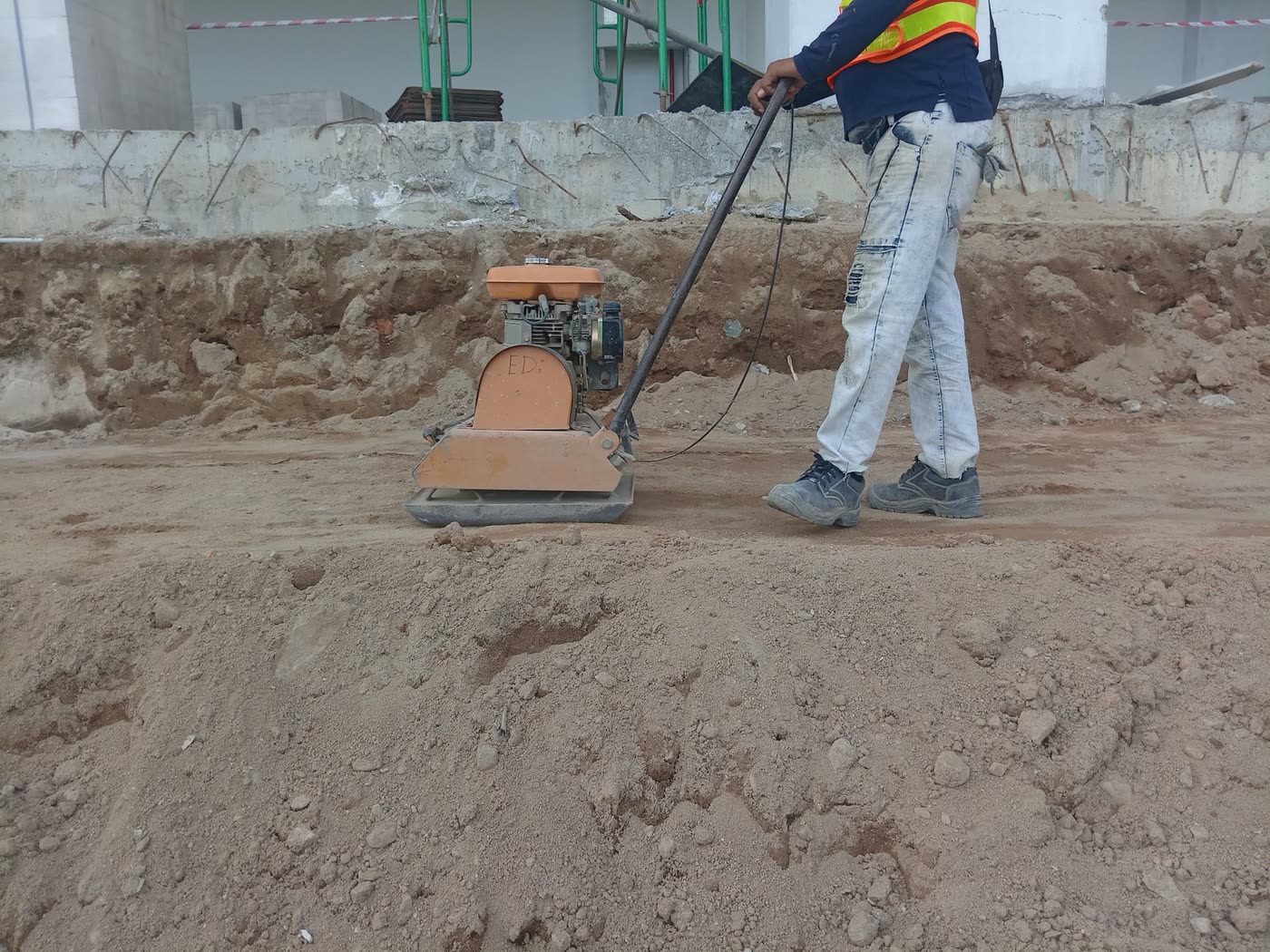
The depth that matters is the compacted depth. Lay Type 1 in layers, compacting each one with a plate compactor or roller, rather than tipping the full depth in one go and running a plate over the top. A deep loose layer only compacts at the surface, and the bottom stays soft.
Ordering it: bulk bags or loose loads
- Bulk bags
Easy to handle on a small job, and they can sit on the drive or the pavement for a day. Each bag is roughly a tonne or less, so check what your merchant's bag actually holds.
- Loose tipped loads
Cheaper per tonne on larger jobs, but the lorry needs room to tip, and a heap on the road may need council permission first. The dropped kerb guide covers the council side of working at the front of a property.
Running short is worse than having a little left over. A part load ordered on the day costs more per tonne, and the job stops while you wait for it.
The mistakes that cost the most
- Using the loose volume. Ordering for the depth you want after compaction, then measuring the loose heap, leaves you short.
- Digging too shallow. The sub-base needs room. If the dig stops short, the drive either sits too high against the house or the sub-base ends up thinner than planned.
- Skipping the edges. The sub-base should run out under the edging, not stop at the inside face of the kerbs. The driveway edging guide explains why.
- Wet or frozen ground. Laying Type 1 onto standing water or frozen ground ruins the compaction underneath.
Getting the sub-base right is most of the work in a driveway that lasts. If you are weighing up doing it yourself, the new driveway cost guide shows how much of a professional price is groundworks rather than the surface.
Written and reviewed by the PaveLocal team. We build and specify driveways across Northamptonshire, Buckinghamshire and Bedfordshire. Pricing and specification guidance on this page reflects what these jobs cost and involve in this region, not a national average.